
The last land I saw was a smear of brown hills dissolving into morning mist off the coast of Japan. For 62 days after that, my world measured roughly nine metres from bow to stern — and in every other direction, it stretched to the edge of the earth.
Before the Wind
I had been planning the crossing for three years. Not obsessively, not with charts taped to every wall, but in the quiet, persistent way that a plan you actually intend to carry out takes root in the back of your mind. I kept a notebook — spiral-bound, water-damaged before I even left — filled with weather windows, provisioning lists, and second-guesses.
My boat was a 30-foot sloop I had bought second-hand in Kobe and slowly, over eighteen months, made seaworthy. I named her Kata, a Japanese word that carries the dual meaning of form and shoulder. I liked the idea that she would carry me, and that crossing an ocean requires a certain form — a discipline that becomes almost meditative when you have no choice but to keep to it.
Friends were enthusiastic and then quietly alarmed in inverse proportion to the departure date. My mother presented me with a laminated card of emergency frequencies. A colleague gave me a novel about a shipwreck. I provisioned for ninety days, filed my float plan with the coastguard, and on a Tuesday in late January, I left Osaka Bay on a northwest wind and pointed Kata's bow east.
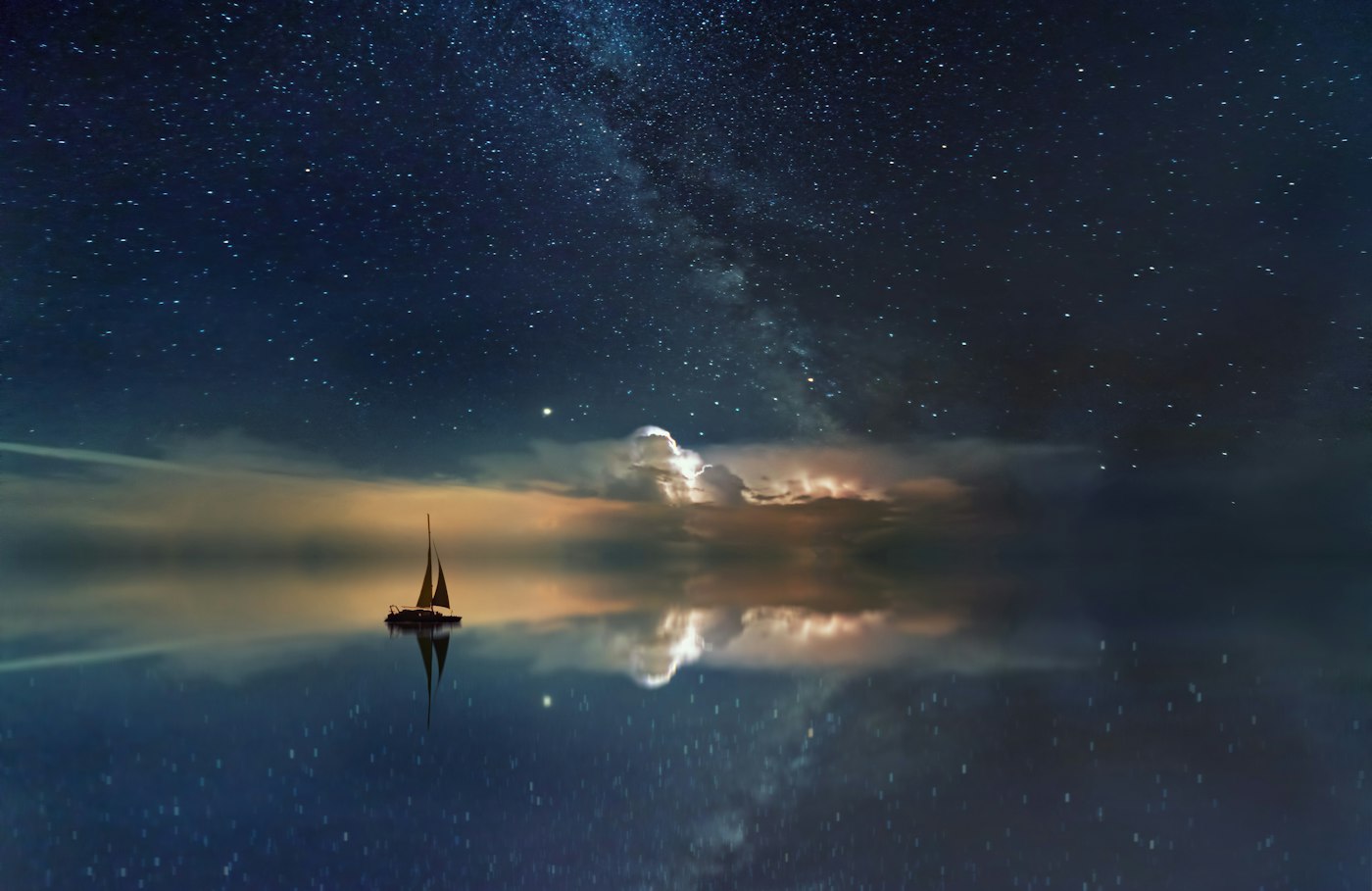
"When land disappears, you stop being a person with a life and become, simply, a person. It is the most clarifying thing I have ever experienced."— Akemi Tanaka, Solo Pacific Crossing
Forty Days of Nothing
By day ten, the rhythm had established itself. Wake at dawn, check the instruments, eat something warm, log the position. Manage the sails through the morning. Read, or think, or do neither. Check the sky in the afternoon. Cook. Watch the stars until sleep took over. Repeat.
I want to be honest about this: there were stretches of boredom so absolute that it felt almost physical. The Pacific is not a dramatic ocean in the way the North Atlantic is dramatic. It is slow and blue and impossibly vast, and for long sections of the crossing it offers nothing to engage with. No ships. No birds. No clouds worth mentioning. Just water and the sound of the hull moving through it.
But within that emptiness — and I did not expect this — there was something that functioned like joy. Not happiness exactly, not contentment. More like a clearing. I had carried a great deal of mental noise out of Osaka Bay: work anxieties, conversations I was rehearsing, the usual texture of a life lived too close to a screen. It took about two weeks for that noise to fall away. When it did, I started to notice things. The particular quality of light at 4 a.m. The way a wave three hundred metres away registers as a sound before it registers as a shape.
Around day thirty-five, I hit a patch of weather that lasted six days. Not a storm, exactly, but a sustained gale from the north that pushed confused seas and kept me below deck for most of each day. I slept in wet clothes. I ate crackers and instant noodle soup. The satellite phone confirmed what I already knew: there was no routing around it. I had to go through.
On the fifth night, exhausted and slightly feverish, I made an entry in my logbook that I have returned to many times since. It reads: The boat knows what to do. Trust the boat. I had been fighting the conditions, adjusting constantly, second-guessing every decision. When I finally stopped fighting and let Kata find her own angle through the chop, the passage immediately became easier. I am still not sure whether this is a lesson about sailing or about something else entirely.
The Other Side
On day fifty-eight, I saw a container ship on the horizon — the first vessel I had encountered since leaving Japan. I did not hail it. I watched it cross from port to starboard over the course of about an hour and felt, unexpectedly, a mild irritation at its presence. My ocean, my solitude. Irrational, I know. But forty-something days without another human being does something to your sense of property.
The coast of California appeared on day sixty-two as a low, tawny smudge on the western horizon. I had been tracking my position precisely for weeks, but the actual sight of land — physical, undeniable — hit me in a way I had not anticipated. I sat on the foredeck for a long time just looking at it. Mountains. Trees. The complicated, expensive, beloved world.
I motored into the marina at San Francisco on a gray afternoon in late March. A marina worker took my lines and asked if I had come far. "From Japan," I said. He nodded, as if this were a normal thing, and went back to his ropes. I sat in the cockpit for another hour before I could bring myself to go ashore.
People ask me, inevitably, whether I would do it again. The honest answer is that I do not need to. Not because it was not worth doing — it was the most important thing I have ever done — but because I took what I went to find. The crossing gave me something I am still, more than a year later, slowly unpacking: a different relationship to silence, to time, to my own company.
Solo travel, in whatever form it takes — whether across an ocean or across a city you have never visited alone — is essentially an exercise in finding out what you are like when there is no one else to shape you. The Pacific just happens to be a very thorough way of conducting that experiment.